
Learn About 3D Printing
3D printing doesn’t have to be complicated. This page explains the basics in a clear and practical way—so you know what to expect, what works best, and how to get the right result for your project.
What Is 3D Printing?
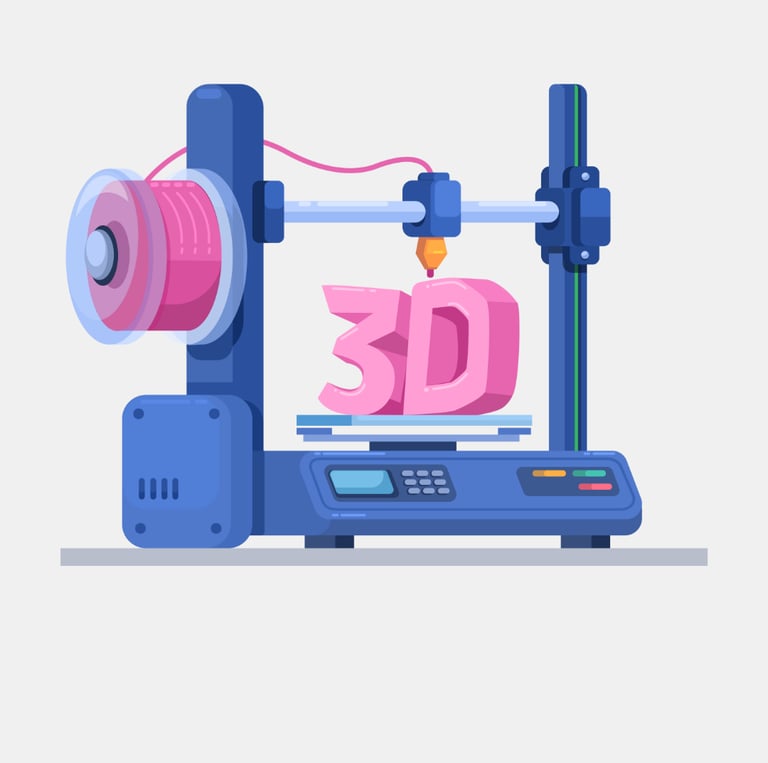
3D printing is a manufacturing process where objects are created layer by layer from a digital design. Instead of cutting material away, the part is built up precisely based on the design.
What Is FDM 3D Printing?
FDM (Fused Deposition Modeling) is the most practical and widely used type of 3D printing.
It works by:
Melting plastic filament
Depositing it layer by layer
Building strong, usable parts
FDM is ideal for custom parts, brackets, mounts, prototypes, and small-batch production.
What Can (and Can’t) Be 3D Printed?
Best Uses for FDM 3D Printing
Brackets, mounts, and fixtures
Replacement and discontinued parts
Equipment supports and risers
Prototypes and test parts
Functional giveaways and custom items
Limitations to Keep in Mind
Not ideal for mass production
Extremely high-heat or high-load metal parts require other methods
Surface finish may show layer lines (this is normal for FDM)
Materials Explained
PETG
Best for:
Functional parts
Slight outdoor exposure
Parts that need more durability
Pros: Stronger and more flexible than PLA
Cons: Slightly more visible layer lines
Not sure which material to choose? We help recommend the right one for your use case.
PLA / PLA+
Best for:
Indoor use
Decorative and functional desk items
Prototypes and giveaways
Pros: Easy to print, clean finish, cost-effective
Cons: Not ideal for high heat or outdoor use
Other Filaments
ABS (Acrylonitrile Butadiene Styrene) is a strong, impact-resistant plastic commonly used in 3D printing and prototyping.
TPU (Thermoplastic Polyurethane) is a flexible and durable material that is ideal for producing rubber-like parts and objects.
CAD & STL Files Explained
What Is an STL File?
CAD (Computer-Aided Design) is used by professionals to create and optimize designs using software, replacing manual drafting with digital models.
Do I Need an STL File?
No.
If you don’t have one, we provide custom CAD design.
If You Already Have an STL File
You can skip the design step and avail our 3D printing service directly.
Can You Edit Existing STL Files?
Yes—simple modifications and adjustments are possible depending on the file.
What is CAD / CAD design?
An STL file is a digital 3D model used for printing. It tells the printer the shape of the object.
Why Custom CAD Design Matters
Off-the-shelf designs often:
Don’t fit correctly
Don’t account for real-world use
Require compromises
Custom CAD design ensures:
Proper fit
Correct clearances
Strength where needed
A part designed for its actual purpose
Common Questions (FAQ)
Is FDM 3D printing strong?
Yes—when designed correctly, FDM parts are strong enough for many functional applications.
What materials work?
We print with PLA, ABS, PETG, and flexible filaments depending on your project.
How long does printing take?
Print time depends on size and complexity; small parts can take under an hour.
Do you offer design help?
Yes, we assist with file preparation and design tweaks for printing.
Can I order just one piece?
Yes. One-off prints are welcome.
When Should I Choose 3D Printing?
Choose 3D printing if you need:
Custom-fit parts
Low to medium quantities
Fast turnaround
Design flexibility
Get in Touch
Reach out for custom 3D printing solutions.
Email:
Phone:
cubectrl.project@gmail.com
+63 945 8861 843
© 2025. All rights reserved.
+63 932 5889 079